
Why Play Is the Most Underrated Training Tool
- pawsnclawstraining
- Dec 10, 2025
- 3 min read
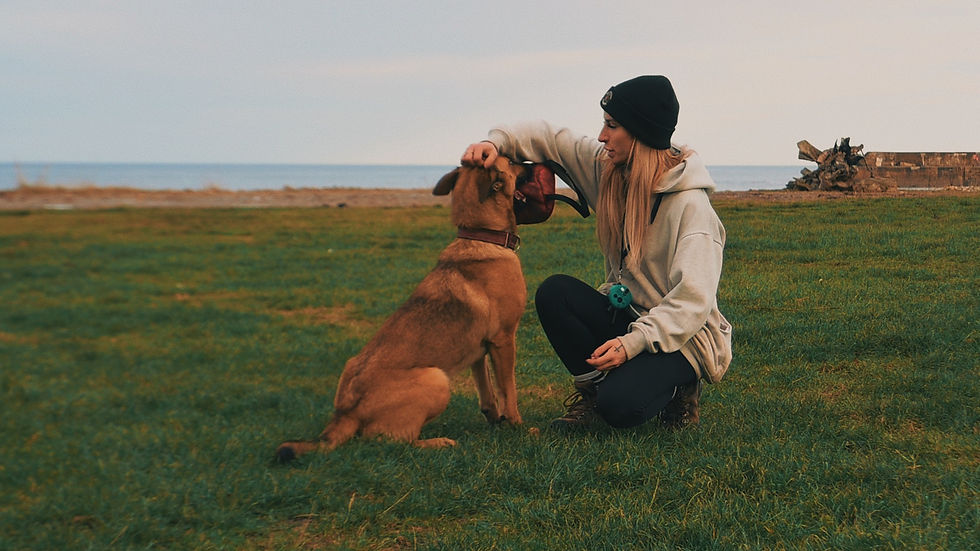
When most people think about training, they picture treats, cues and maybe a training class. Sounds a bit boring right?
What they don’t realise is that play is one of the most powerful training tools they have and it can often be overlooked.
Play isn’t just about blowing off steam, although it is a great outlet. Done well, it can also:
Build confidence
Supercharge motivation
Improve recall
Improve impulse control
Strengthen your relationship
Help prevent resource guarding
And the best part? Its FUN for both you and your dog. Even if they don’t naturally have tons of toy drive, we can build that motivation
What good play really does for your dog
Builds confidence
Shy or sensitive dogs often shine through, structured play:
They practise moving their body, grabbing, chasing or searching in a safe way.
They get to “win” the toy, finding the thing, bringing it back.
They learn that interacting with you is predictable and fun.
Over time, those little wins add up to a more confident dog in other areas of life too.
Increases motivation and recall - If you are fun, your dog will choose you more.
Play can make you:
More interesting than the environment
Worth running back to when you call
Someone your dog wants to engage with, not just has to
Teaches impulse control in real arousal. We can teach a dog to sit politely in the kitchen quite easily. What’s harder is helping them think when excited.
Play is perfect for this:
You deliberately let arousal go up (chasing, tugging, searching).
You ask for a brief pause, maybe a “stop”, “out” or a moment of stillness.
Then you start the game again on cue.
The dog practises:
Pausing when they’re excited
Letting go of something they value
Re-engaging when asked
If you can recall a dog from a thrown ball.. you bet, you can recall them from chasing another animal!
That skill transfers to other situations: greeting people, walking past dogs, coming away from wildlife, etc.
Reduces conflict and prevents behaviour problems. So many issues around toys, chews and stolen items come from conflict:
Dog picks something up → human chases → grabs it away → game over.
Dog learns: “When you come near my stuff, I lose it.”
Play done well:
Rewards the dog for bringing things towards you
Uses swaps rather than snatching
Teaches that your approach means more fun, not the end of fun
This can prevent (and often help with) resource guarding and those daily battles over socks, toys and chews.


Simple rules for better play
You don’t need to be perfect. These few rules will already transform things:
Start where your dog is, if they don’t love toys (yet):
Move toys away from your dog, low and jolty, rather than poking them in the face.
Keep early sessions very short, 10–20 seconds at a time.
Keep toys as a team game
Rather than waiting for your dog to decide whether to bring toys back, set things up so toys only exist as a shared activity with you.
Practically, that looks like:
Toys only come out when you’re playing together, they’re not lying around for the dog to take off and self-entertain with.
Your dog wears a lead during play, so they don’t get to rehearse grabbing the toy and running off to enjoy it alone. They learn that the fun lives with you.
Even if your dog just wants to sit and chew a ball or toy, clip the lead on and simply sit next to them and share it. I like to sit on the floor and calmly enjoy the toy with the dog, stroking them, occasionally holding the toy for them, maybe adding the odd gentle tug or tiny bit of movement if they enjoy that.
This way, your dog never gets reinforced for taking the toy away to entertain themselves.Instead, they learn that:
Toys appear with you
Toys stay near you
And the best part of toys is doing something together, not running off alone
Teach start/stop cues in play
Even if you’re only doing tiny games, add:
A start cue “Play!”, “Let’s go!”, etc.
A stop moment, toy goes still, you become boring for a second, dog lets go.
And then a restart, back to play when they’ve let go or paused.
This helps your dog:
Learn to handle excitement without tipping over
Understand that “stop” doesn’t mean “game over forever”
Always end while they still want more
Top Tip: End the game slightly earlier than your dog would choose. Never wait for them to check out first.
If they’re still engaged and happy when you stop, their motivation for you and your games just keeps growing.
Play isn’t just a bonus, it’s a foundation.
It shapes behaviour.
It builds your bond.
It gives your dog an outlet for natural instincts.
And it’s something you can teach, even to dogs who aren’t naturally toy-mad.


Comments